A garden can be full of healthy plants and still have long stretches with few flowers. The problem is often timing: several favorites bloom together, then finish together. Planning a succession of blooms means arranging overlapping flowering periods so the next group is ready as the previous one fades.
This is different from repeatedly sowing crops for a rolling harvest. Here, the goal is to coordinate the flowering windows of plants in a mixed ornamental bed. A bloom calendar helps, but it works best as a planning tool you update with local observations, not a promise that every plant will flower on a fixed date.
Start with the season your garden actually has
Decide which part of the year you want to cover. In a cold climate, that may mean spring through fall rather than outdoor flowers in every month. Write down your location, light conditions, soil, and available space before making the plant list.
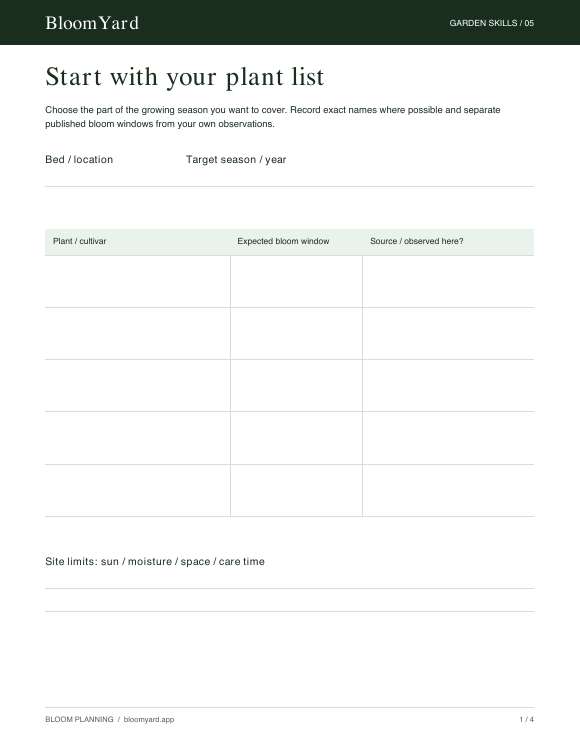
Then list what is already growing. Record the species or cultivar, approximate flowering period, and whether the timing comes from your own garden or a published description. Keep those two sources separate. A label saying “summer” is useful, but it does not tell you exactly which weeks the plant will carry your bed locally.
University of Maryland Extension recommends observing flowering times in nearby gardens when planning combinations. Local public gardens and established neighborhood plantings can help you see both overlapping flowers and quieter periods.
University of Maryland Extension: choosing and caring for perennials
Build a calendar with overlapping windows
Give each plant a row and each month, or part of a season, a column. Mark its expected flowering window. If the source is vague, shade a broad range and label it provisional rather than inventing precise dates.
Read the calendar vertically. Which periods have several plants flowering? Which have only one? Which are empty? This simple check changes the question from “What flower should I buy?” to “What could flower during this gap and thrive in this bed?”
Consider a hypothetical plan with plants A and B flowering in late spring, plant C in midsummer, and plant D in early fall. The weak point may be the transition between spring and midsummer. Adding another spring favorite would increase the peak display without solving that transition. A suitable early-summer plant would be a more targeted addition.
Avoid making the whole plan depend on one plant starting exactly when another stops. Overlap gives you room for variation. Some plants may flower earlier, later, or less generously than expected in a particular year.
Fill the gap with a plant that fits the site
A missing month is only the first filter. Check the candidate's sunlight, moisture, soil, hardiness, mature size, and growth habit before giving it a place in the plan. A late-flowering plant that cannot thrive in the bed is unlikely to solve the gap for long.
Cultivar choice can change timing within a familiar plant group. University of Minnesota Extension explains that daylily cultivars have differing bloom periods, which can be combined to extend their display. Treat that as an example of why exact names matter, not a reason to fill every garden with daylilies.
University of Minnesota Extension: daylily flowering periods
Use your sunlight notes, soil observations, and spacing plan alongside the calendar. When no suitable plant fits an empty period, a container in a better location may be more practical than forcing another perennial into a crowded bed.
Separate flower coverage from overall garden interest
A bed does not have to rely entirely on flowers to remain appealing between peaks. Leaf shape, foliage color, seedheads, and structural plants can keep the planting visually coherent while the bloom sequence changes.
Mark these features separately on your plan. A striking seedhead is not an open flower, and colorful leaves do not fill a floral-food gap for pollinators. If supporting pollinators is one of your goals, evaluate actual flowering coverage and locally appropriate plant choices as a separate layer.
University of Minnesota's pollinator guidance emphasizes flowers across the growing season. A succession calendar can help you notice gaps, but flowering dates alone do not tell you whether a particular flower provides accessible food for the insects you want to support.
University of Minnesota Extension: planting for pollinators
Include the care you are willing to do
Some plants rebloom or continue flowering with suitable care; others have one main flowering period. Do not count on deadheading to make every perennial flower again. Check the specific plant's guidance and record any maintenance your plan depends on.
There can also be a tradeoff between removing spent blooms and leaving seedheads. Decide what matters in that part of the bed: another flush of flowers where possible, seeds and structure, or reduced maintenance. A plan that requires more work than you want to do needs adjustment before planting.
As the season unfolds, record first bloom, peak bloom, and the end of the main display. Photos from the same viewpoint make comparisons easier. Update the calendar after a full season rather than treating one unexpected week as a reason to replace healthy plants.
Make one improvement at a time
Choose the most noticeable gap and compare two or three suitable candidates. Record why you favor one, where it will fit, and what you expect it to contribute. Then watch the result before expanding the plan.
The free Bloom Planning Workbook includes a plant inventory, a twelve-month bloom calendar, a gap-to-plant comparison, and a season review. Get your Bloom Planning Workbook and start with the bed you already have. The useful goal is a sequence that fits your garden, your climate, and the care you want to give it.