
A flower bed can look ready to plant and still leave you wondering why some plants flourish while others struggle. Before buying another bag of fertilizer, get to know what is happening below the surface.
Learning how to test garden soil starts with three questions: What does it feel like? How does water move through it? What does a laboratory test say about its chemistry? Together, those answers help you decide what to improve and what to plant.
Start with one bed. You do not need to diagnose the whole yard in a weekend. This guide is for outdoor, in-ground flower beds; container mixes need a different approach.
1. Understand your garden soil type
Soil texture describes the proportions of sand, silt, and clay. Most garden soils contain all three. Sandy soil feels gritty, silt feels smoother, and clay becomes sticky when wet. Loam is a texture class that combines these particles; it is not another name for compost.
Texture gives clues about water and nutrient retention. Sandy soils tend to drain quickly, while clay-rich soils tend to hold more water. But texture alone does not tell you whether a bed drains well: compaction and layers below the surface also matter. University of Maryland Extension: Soil Basics
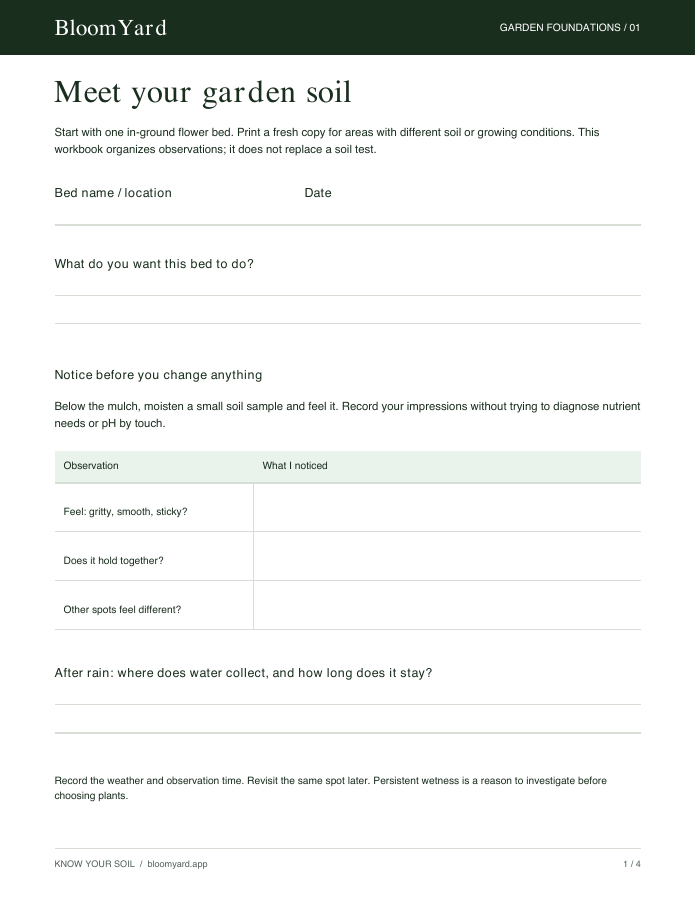
Try a simple feel check. Take a small sample from below the mulch, remove stones and roots, and moisten it gradually. Rub it between your fingers. Record whether it feels gritty, smooth, or sticky, and whether it holds together when squeezed. Repeat in another part of the bed.
Treat this as an observation, not a precise classification. It cannot tell you the soil's pH or fertilizer needs. If two areas feel very different, label them separately in your notes.
2. Check what happens after rain
Walk the bed after rainfall and return later. Record where water collects, whether it is still there the next day, and whether nearby pavement or a downspout sends extra water into the bed. Take photos from the same position so you can compare observations.
A persistently wet corner calls for a closer look before planting. University of Maryland Extension provides a drainage test: dig a hole about 12 inches wide and deep, fill it, and refill the next day. Water dropping less than an inch per hour signals slow drainage that needs investigation. Check for buried utilities before digging. Drainage test and interpretation
Record weather alongside the result. A single observation is a starting point; a spot that behaves differently across seasons needs more than a one-day label.
3. How to test garden soil through a lab
Use a soil laboratory recommended by your local university extension service. Check what the selected test includes: pH, nutrients, and organic matter may be reported, but packages differ. Tell the lab that you are planning a flower garden so its recommendations match the intended use. University of Minnesota Extension: Soil Testing
Collect a representative sample rather than scooping from one convenient spot:
- Read the lab's instructions for sampling depth, tools, quantity, and packaging.
- Remove surface mulch and collect small portions from several places within one similar growing area.
- Combine those portions in a clean container as directed by the lab.
- Keep distinctly different areas or problem patches in separate, labeled samples.
- Submit the requested amount with the bed name and intended plants.
Follow the lab's directions for drying and shipping. Keep a copy of the submission with your results. University of Minnesota Extension: Soil Sampling Guide
Make the label useful. “Front bed beside driveway” will be easier to remember than “Sample A.” Put the same label on your worksheet, sample bag, and garden sketch.
4. Improve what the results actually identify
Give roots better growing conditions
Compost can improve soil structure, but adding it does not turn clay into a different texture. Avoid working wet soil, limit foot traffic through beds, and do not use sand as a quick clay-soil fix. Persistent drainage problems need their cause identified; compost cannot solve every wet site. University of Maryland Extension: Improving Soil
Match additions to the report
Use the lab's recommendations for amendments and fertilizer. More compost or fertilizer is not automatically better, especially where nutrients are already abundant. Your report is also the place to start before trying to alter pH. University of Minnesota Extension: Soil Testing
Before buying anything, write down the recommended material, application rate, area covered, and timing. If the units or recommendation are unclear, ask the lab or extension service to explain them. Keep the answer with the report so you can repeat the calculation later.
5. Decide whether to improve the bed or change the plant list
Imagine two beds. One has a test result with a specific amendment recommendation. The other has a recurring puddle, but no diagnosis of its cause. Those beds need different next steps: a measured treatment in the first, more investigation in the second.
Use these prompts to make your own decision:
- Improve: Have I identified a specific problem and a practical, supported way to address it?
- Plant for existing conditions: Can I build a plant list whose documented soil and moisture preferences fit this bed?
- Relocate a favorite: Would the plant I want be better suited to a different bed or a container?
- Investigate: Am I still guessing about persistent wetness, compaction, or confusing test results?
For every candidate plant, compare soil and moisture preferences alongside sunlight, hardiness, mature size, and bloom season. Keep the source of the plant information beside your notes. That makes the final selection easier to check before you buy.
Turn your observations into a plan
The next useful step is small: label one bed, make a few observations, and arrange a soil test. You can develop the planting plan while you wait for results, then revise it using what you learn.
Get the free Know Your Soil Workbook to keep your site notes, test results, and next actions together. It includes a plant-comparison sheet so you can connect your soil observations to your garden choices.
When you are ready to explore plants, visit BloomYard's Plant Library. For the next stage of design, read how to plan for blooms across the season.