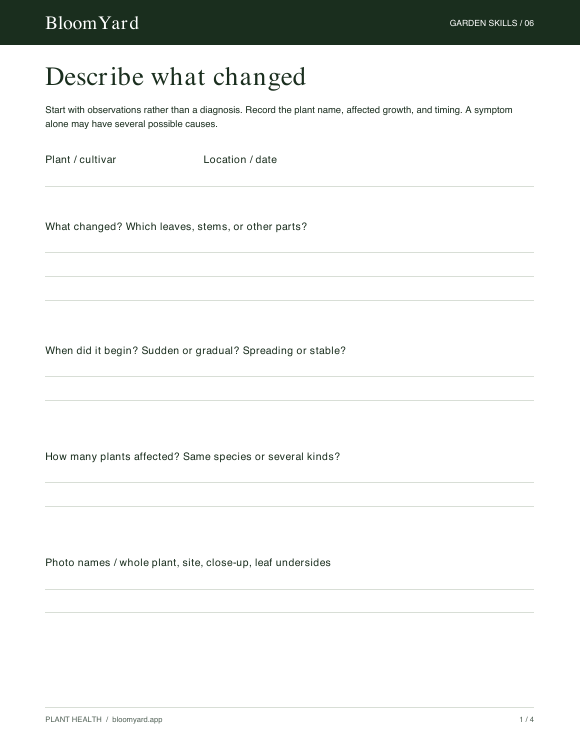
Yellow leaves, holes, and wilting all ask for attention, but none tells you the cause on its own. Learning how to diagnose garden plant problems starts with describing what changed and collecting enough evidence to choose a sensible next step.
That does not mean you need to identify every disease yourself. A useful first assessment can tell you what to monitor, which growing conditions to check, and what information to send to a local expert. The aim is to avoid a chain of guesses in which extra water, fertilizer, and sprays create more uncertainty than they resolve.
Identify the plant and describe the change
Begin with the plant's name, ideally including its cultivar. Add when it was planted, where it grows, and whether the affected growth is old or new. Some seasonal changes are normal; others are unexpected for that species or time of year.
Use descriptive language before diagnostic labels. “Lower leaves have small brown spots with pale margins” is more useful than “It has a fungus.” “One stem wilted yesterday” is different from “The whole planting has declined slowly for a month.”
A symptom is the plant's response, such as yellowing or wilting. A sign is direct evidence of a possible cause, such as visible fungal growth. An insect on a leaf is evidence that the insect is present, but it is not proof that it caused the damage.
Penn State Extension: diagnosing a plant problem
Look at the pattern across the garden
Step back before zooming in. Is one plant affected, several of the same kind, or many unrelated plants? Is the problem concentrated along a path, on one exposed side, or in a low area? These patterns help you decide which explanations deserve investigation.
Check several leaves and stems, including the undersides of leaves. Photograph the whole plant, the surrounding site, and a close view of the symptom. Include an object for scale where useful, and keep photos sharp enough to show the affected area.
Take a second look at a nearby healthy plant of the same kind if one is available. Differences in planting depth, drainage, exposure, or recent work may be relevant. A pattern is a clue, not a diagnosis: more than one cause can produce similar damage.
Penn State Extension: an overview of plant diagnostics
Check the growing conditions before choosing a treatment
Plant problems can come from living causes, such as insects and disease organisms, or nonliving causes, such as moisture stress, temperature extremes, root injury, and chemical damage. University of Maryland Extension explains this distinction as part of integrated pest management, or IPM.
Review what happened before symptoms appeared. Was the plant moved? Did irrigation change? Was there a heat wave, frost, unusually wet period, nearby digging, or an application of fertilizer or another product? Record dates and product names if known. Do not fill missing information with assumptions.
Check soil moisture rather than assuming a wilted plant is dry. Compare the actual sunlight with the plant's needs. If you suspect a nutrient issue, use appropriate testing and local guidance rather than choosing fertilizer from leaf color alone. Several problems can occur at the same time.
University of Maryland Extension: identifying and managing plant problems
Our watering guide, sunlight guide, and soil guide can help you organize those site checks.
Decide whether to monitor, investigate, or act
IPM combines identification, monitoring, prevention, and suitable control methods. It does not assume every insect or imperfect leaf needs treatment. The amount and progression of damage matter, along with the plant's condition and your goals.
If damage is minor and the plant is otherwise growing normally, monitoring may be a reasonable next step while you seek an identification. Record what you will recheck and when. If damage is spreading quickly, several plants are declining, or the cause remains unclear, contact your local extension service or a plant diagnostic clinic promptly.
Look up an insect before removing or treating it. Some insects are predators of pests, and others may simply be passing through. University of California IPM provides identification and management resources for home gardens, including beneficial organisms and plant-specific problems.
University of California IPM: home and landscape resources
When a cause is supported by evidence, choose a response that addresses it. That might mean correcting irrigation, improving an unsuitable planting situation, removing a confirmed pest by an appropriate physical method, or following a targeted treatment recommendation. Avoid applying several unrelated fixes at once: it makes the outcome harder to interpret.
Ask for help with a useful evidence packet
Send the plant name, location, timeline, photos, affected parts, and recent care history. Note how many plants are affected and whether the problem is changing. Explain what you have already tried and what happened afterward.
Check the diagnostic service's instructions before collecting or shipping samples. The right sample and handling method depend on the suspected problem. A photo may be enough to suggest the next check, but some conditions need a physical sample or laboratory work.
If a pesticide is recommended, verify that the product label covers the plant and intended use, and follow all directions and precautions. More product or more frequent application is not a substitute for correct identification. This guide does not prescribe a spray or treatment rate.
Record the response and reassess
After taking an action, note the date and exactly what changed. Review new growth and the progression of symptoms rather than expecting damaged leaves to become perfect again. If the plant continues to decline, revisit the explanation with your evidence instead of automatically repeating the same treatment.
The free Plant Health Workbook provides a symptom record, site and care history, evidence checklist, and action-and-review log. Get your Plant Health Workbook. It helps you make a clearer assessment and ask better questions; it does not replace a confirmed diagnosis when one is needed.